Requirement Management Tool - Why Automotive and IoT Teams Can't Afford to Skip One

 Requirement Management Tool - Why Automotive and IoT Teams Can't Afford to Skip One
Welcome back to MBSE Explained! If you've spent any time in automotive or embedded systems development, you've probably heard the phrase "the requirement wasn't clear" right before a project blew its budget or missed a milestone. That sentence is usually the tip of a much bigger iceberg.
In this post, I want to talk about something less glamorous than SysML diagrams or digital twins, but arguably more foundational: the requirement management tool. Having spent nearly five years as a Model-Based Embedded Software Developer and Architect, followed by a year and a half working as a Model-Based Systems Architect on automotive programs, I've seen firsthand what happens when requirements live in scattered spreadsheets versus when they live in a proper, traceable system.
We'll look at why requirement management (RM) tools matter, the specific failures they prevent, how the same principles apply — at a smaller scale — to ODM IoT hardware projects, and I'll walk through two established tools, Codebeamer and ReqView. I'll also introduce a tool I'm building myself, ODM Trace, aimed at teams that fall in the gap between "spreadsheet chaos" and "full automotive-grade ALM."
Why Requirement Management Tools Matter
In any complex product — a battery management system, a powertrain controller, a converter unit — requirements are the contract between what stakeholders need and what engineers build. When that contract lives in disconnected Word documents, emails, and Excel tabs, it stops being a contract. It becomes a rumor.
A dedicated RM tool exists to keep that contract enforceable:
- Single source of truth — everyone works from the same, versioned requirement, not five copies with different edit dates.
- Traceability — every requirement links forward to design and test, and backward to its origin (customer need, standard, stakeholder ask).
- Change impact analysis — when a requirement changes, you immediately see what design elements, tests, and risks are affected.
- Audit readiness — for regulated domains, you need a defensible history of who approved what, and when.
None of this is optional once a project passes a certain complexity threshold. The question isn't whether you need traceability — it's whether you're going to get it from a purpose-built tool, or the hard way, during a failed audit.
The Failures Requirement Management Tools Actually Prevent
It's easy to treat RM tooling as bureaucratic overhead — until you've lived through the alternative. Here are the failure modes I've personally seen an RM tool prevent (or, in their absence, cause real damage):
Silent requirement drift. A requirement gets "clarified" in a hallway conversation or a Slack message, the spreadsheet never gets updated, and three teams downstream build against the old version. Nobody notices until integration testing.
Untraceable late-stage defects. A defect surfaces during validation, but nobody can quickly answer "which requirement does this violate, and who approved it?" Without traceability, root-causing turns into an archaeology dig instead of a five-minute query.
Orphaned requirements. Requirements get written, but never linked to a test case or a design element. They sit there unverified until an assessor — or worse, a field failure — finds them.
Duplicate or conflicting requirements. Two teams write slightly different versions of "the same" requirement in two different documents. Nobody reconciles them until implementation reveals the conflict.
Compliance gaps that surface at the worst possible time. In automotive, standards like ISO 26262 expect demonstrable bidirectional traceability from safety goals down to verification. Discovering a gap during a functional safety assessment — instead of during development — is expensive and, in the worst case, program-threatening.
Change requests with no visible blast radius. A last-minute change to a converter system's requirement ripples into hardware, firmware, and test plans, but without linked traceability, someone finds out about the ripple only after it breaks something.
An RM tool doesn't eliminate human error. What it does is make the error visible early, instead of letting it hide until it's expensive.
Automotive vs. ODM IoT: A Parallel in Complexity, Not in Need
Automotive systems engineering operates under heavy regulatory weight — ISO 26262 for functional safety, ASPICE for process maturity, and often ISO 21434 for cybersecurity. A single powertrain ECU can carry thousands of interlinked requirements, each needing a traceable path to hazard analysis and verification.
ODM IoT hardware projects — think a connected sensor device, a smart home gateway, or a wearable built by an ODM for a brand customer — don't carry that same regulatory load. But the underlying engineering problem is structurally identical:
- A customer requirement ("the device must run 12 months on battery") still needs to flow down into system, hardware, and software requirements.
- Changes still need impact analysis before they're approved.
- Teams still need to know who approved what, especially when a brand customer is signing off on a specification.
- Excel and email still silently fail at scale — just at a smaller scale than automotive.
The difference is one of degree, not kind. Automotive needs a heavyweight, standards-certified ALM platform because the regulatory and safety stakes demand it. ODM IoT teams need the same discipline — hierarchy, traceability, approvals — without the certification overhead, integration complexity, or price tag that comes with automotive-grade tooling. That mismatch is exactly where a lot of ODM hardware teams get stuck: too complex for spreadsheets, but automotive ALM platforms are overkill for their scale and budget.
Tool Overview: Codebeamer
Codebeamer, now part of PTC, is a comprehensive Application Lifecycle Management (ALM) platform rather than a standalone RM tool. That's its defining characteristic: requirements management sits alongside built-in risk management, test management, and change management, all within one connected environment.
What stands out:
- End-to-end traceability across requirements, design, risk, and test artifacts, with a traceability browser for drilling into upstream/downstream impact.
- Built-in compliance support for standards relevant to automotive (ISO 26262), aerospace (DO-178C), and medical devices (IEC 62304, ISO 13485), which matters a great deal if you're preparing for a functional safety assessment.
- Integrations with tools like Jira, GitHub, MATLAB Simulink, and PTC Windchill, so it can sit at the center of a broader engineering toolchain rather than replacing it.
- Configurable, no-code workflows, letting teams tailor approval and review processes without custom development.
Where it fits: Codebeamer is built for mid-to-large engineering organizations working on complex, safety-critical, or heavily regulated products — exactly the profile of most automotive OEM and Tier 1 programs. The tradeoff is that this depth comes with real implementation and licensing overhead, which is difficult to justify for a small ODM hardware team shipping a connected sensor.
Tool Overview: ReqView
ReqView takes a very different design philosophy. It's a lightweight, desktop-first requirements management tool, built specifically around structured requirement capture and traceability — without trying to be a full ALM suite.
What stands out:
- Fast setup, low overhead. Teams routinely describe it as easy to deploy and maintain, without the IT footprint of a large ALM platform.
- Structured, tabular requirement capture, close to how engineers already think in spreadsheets — but with proper attributes, discussion threads, and traceability links instead of static cells.
- Traceability and impact analysis, including a traceability matrix and side-by-side version comparison, plus built-in FMEA-style risk management.
- Git/SVN-based version control, which appeals to engineering teams that already live in a version-controlled workflow rather than a database-backed web platform.
- Standards alignment, including templates based on ISO/IEC/IEEE 29148, and use across medical, aerospace, and automotive customers.
Where it fits: ReqView is a strong choice for small-to-mid teams that need genuine traceability and structured requirements without committing to a heavyweight ALM platform. It's noticeably closer to the ODM IoT profile than Codebeamer — but it's still a general-purpose RM tool, not one built around the specific customer → stakeholder → system → hardware → software hierarchy that ODM hardware programs actually work in.
The Gap in the Middle — and Why I'm Building ODM Trace
Here's the pattern I kept running into: automotive-grade tools like Codebeamer are powerful but heavy, built for organizations with dedicated ALM administrators and compliance teams. General-purpose lightweight tools like ReqView close some of that gap, but they're still not shaped around the specific workflow an ODM IoT hardware team lives in — where a brand customer hands you a spec, and you need to trace it cleanly down through system, hardware, and software requirements, with the right person approving each stage.
That's the gap I'm building ODM Trace to fill.
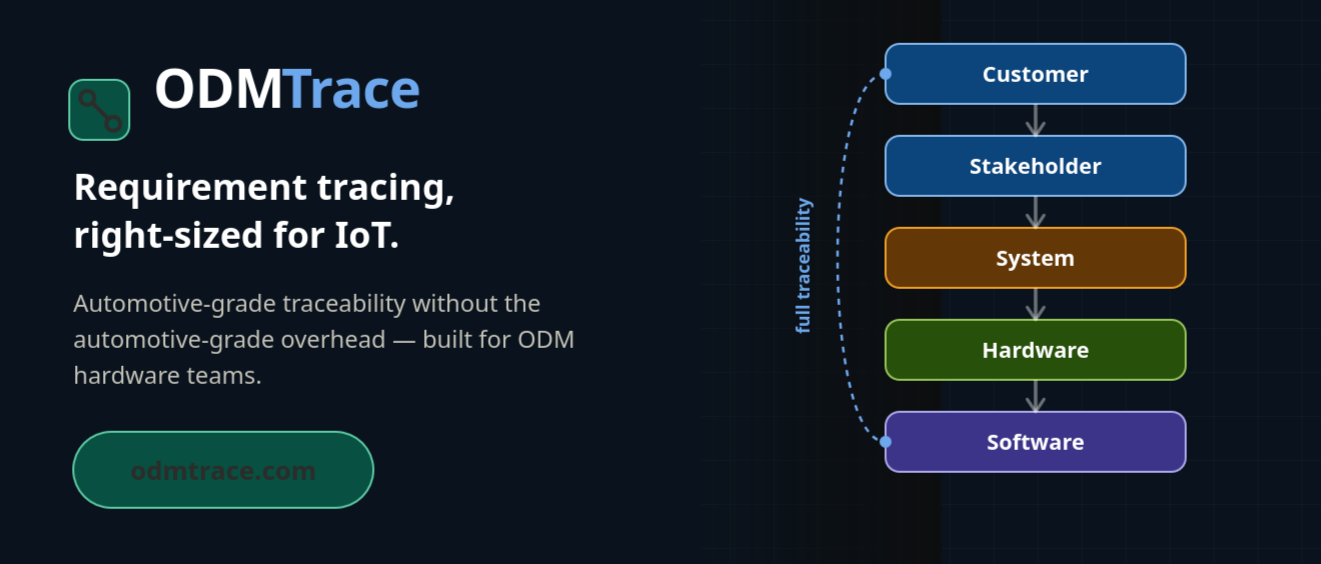
ODM Trace is a simple requirement management tool built specifically for ODM IoT hardware teams, structured around a five-level hierarchy — Customer → Stakeholder → System → Hardware → Software — where every child requirement automatically links back to its parent. A few things I'm deliberately designing it around:
- Type-specific approvals — a Customer Requirement routes to a PM, a Hardware Requirement routes to a HW Lead, and so on, with mandatory comments on rejection so nothing gets silently bounced.
- Excel import, done right — because ODM teams will keep using spreadsheets for first drafts, so the tool needs to meet them there, catching duplicates and missing fields on the way in rather than pretending spreadsheets don't exist.
- A home for MBSE artifacts without forcing MBSE tooling on everyone — deep design work still happens in Cameo, Rhapsody, or similar tools, but the exported PDFs, Word docs, and Excel outputs get versioned and linked back to the requirements they satisfy.
- Dashboards built for both managers and engineers — open requests, approval rates, cycle time, and a live traceability matrix, filtered to what each role actually needs.
The goal isn't to compete with Codebeamer on automotive-grade compliance certification, or with ReqView on general-purpose flexibility. It's to give ODM IoT hardware teams the traceability discipline that automotive programs take for granted, sized correctly for teams that don't have — and don't need — a full ALM deployment. ODM Trace is currently in early development (Phase 1), and I'll be sharing progress here on MBSE Explained as it moves forward.
Choosing the Right Tool for Where You Are
If you're running a safety-critical automotive program with ISO 26262 obligations and a multi-disciplinary engineering org, a platform like Codebeamer is probably worth its complexity. If you're a small-to-mid team that needs real traceability without a heavyweight rollout, ReqView is a genuinely strong fit. And if you're an ODM IoT hardware team caught between "spreadsheets are breaking down" and "we don't need automotive-grade ALM," that's precisely the space ODM Trace is being built for.
Wherever your project sits on that spectrum, the underlying lesson doesn't change: requirements that aren't traceable aren't really managed — they're just recorded, and hoping nobody asks hard questions later.
What's your experience — are you managing requirements in a dedicated tool, or still wrestling with spreadsheets? Share your thoughts below! As always, MBSE Explained is here to keep simplifying systems for smarter EVs — and, increasingly, smarter connected hardware too.