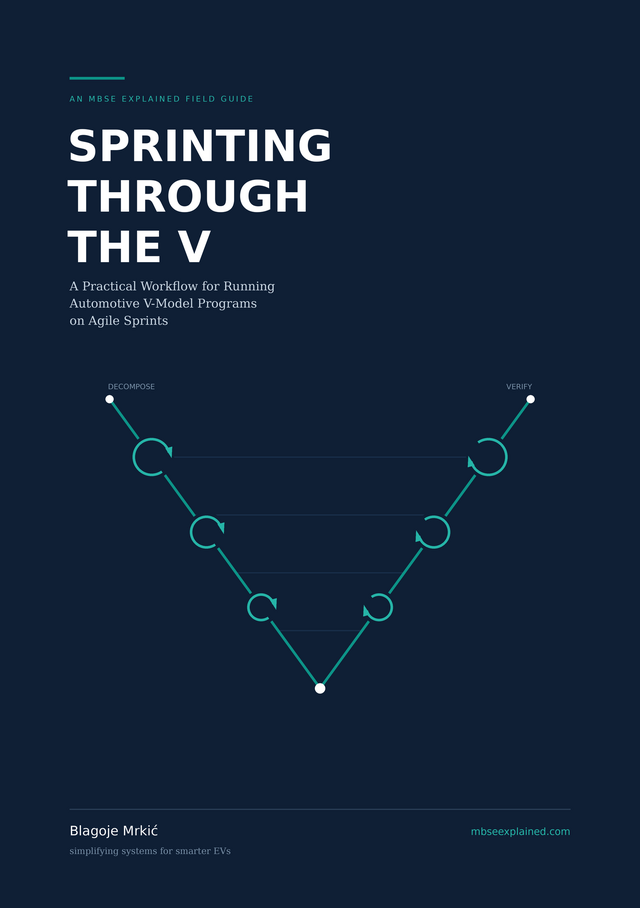
Two calendars, one programme
The first calendar is drawn as a V, anchored to gates, and recognised by your customer, your quality department and your assessor. The second is two weeks long, has a backlog and a board, and is the one your engineers actually live in.
Most organisations run both. Very few run both deliberately. What usually happens instead is that sprints become a reporting layer painted over an essentially sequential process:
- Daily stand-ups about work that cannot finish for another eleven weeks
- Sprint reviews with nothing to demonstrate
- A documentation scramble before every gate
You get the ceremony overhead of agile and the change-resistance of the V — and the benefits of neither.
The V-model is a structure of evidence.
The sprint is a structure of scheduling.
They are orthogonal, and the model is what joins them. Everything in this book follows from taking that seriously.
What's inside
- How to slice the V vertically into sprint-sized backlog items
- How to run a design freeze as a decision rather than a deadline
- How to produce ASPICE and ISO 26262 evidence as a by-product of sprints
- A twelve-week worked example: EV traction inverter
- A ninety-day adoption roadmap, with Definition of Ready / Done checklists
- An honest survey of six workflows already in use — what each gets right, and where it stops
Who it's for
- Systems engineers and architects under Automotive SPICE and ISO 26262 who have been told to “go agile”
- Team leads and Scrum Masters who inherited a V-model programme and a sprint board, and have to reconcile them
- Functional safety and quality managers who need to know what evidence looks like when it is produced incrementally
- Engineering managers weighing up SAFe, Agile SPICE, or something lighter
Who it isn't for: it assumes you already know what SysML, ASPICE, ISO 26262 and a HIL rig are. It is not a Scrum tutorial, not an ASPICE interpretation guide, and not an argument that agile is better than the V.
Get the field guide
Written by a practising model-based systems architect working on production automotive programmes — not a consultant selling a transformation.