ARXML Explained: What AUTOSAR's XML Format Really Is, and the Workflow Around It

 What an ARXML file actually contains: software components, their ports, and the connectors between them — shown here as a diagram instead of raw XML.
If you've worked anywhere near automotive embedded software, you've had this moment: a colleague or a supplier sends you a file ending in .arxml, and you open it expecting something readable — and get a wall of angle-bracketed XML thousands of lines deep, describing what appears to be three software components and a couple of ports. Somewhere in there is the information you actually need. Good luck finding it by eye.
Welcome to MBSE Explained. ARXML is one of those formats that's absolutely central to modern vehicle software and yet rarely explained in plain terms — most engineers meet it through a tool, never quite sure what the file underneath is. This post fixes that: what ARXML actually is, what it describes, where it sits in the AUTOSAR workflow, and why the raw file is so punishing to read. In the next post I'll get into the more pointed problem — what it costs just to look at one — but you need the format itself first.
What ARXML Actually Is
ARXML stands for AUTOSAR XML. AUTOSAR — AUTomotive Open System ARchitecture — is the standard that a large chunk of the industry uses to structure automotive software, so that a braking-controller component from one supplier and an OEM's platform software can be designed against the same rules and actually fit together.
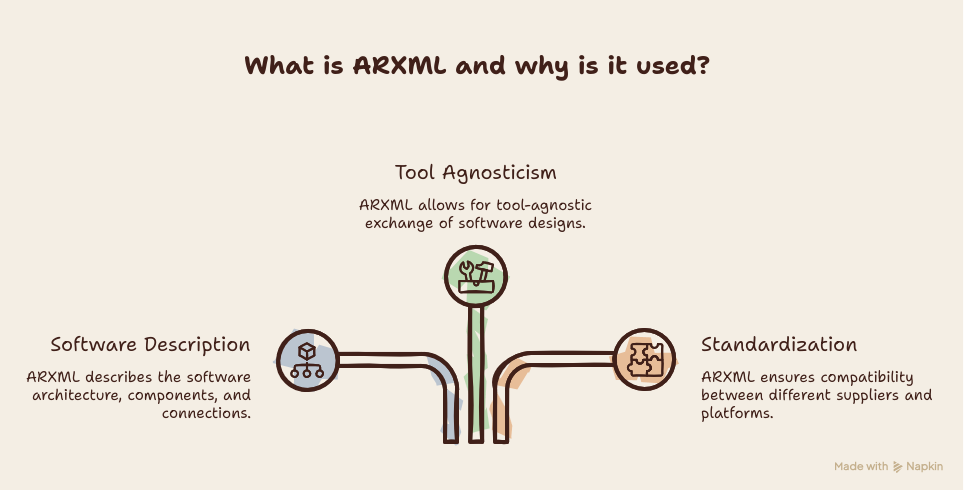
ARXML is the file format AUTOSAR defines to describe that software. It's plain XML, but constrained by an AUTOSAR schema, so every element means something specific and standardized. Crucially, ARXML isn't the code that runs on the ECU — it's the formal description of the architecture: what the software components are, what data they exchange, how they connect, and how they map onto hardware. Think of it as the machine-readable blueprint that the code is generated against and configured from.
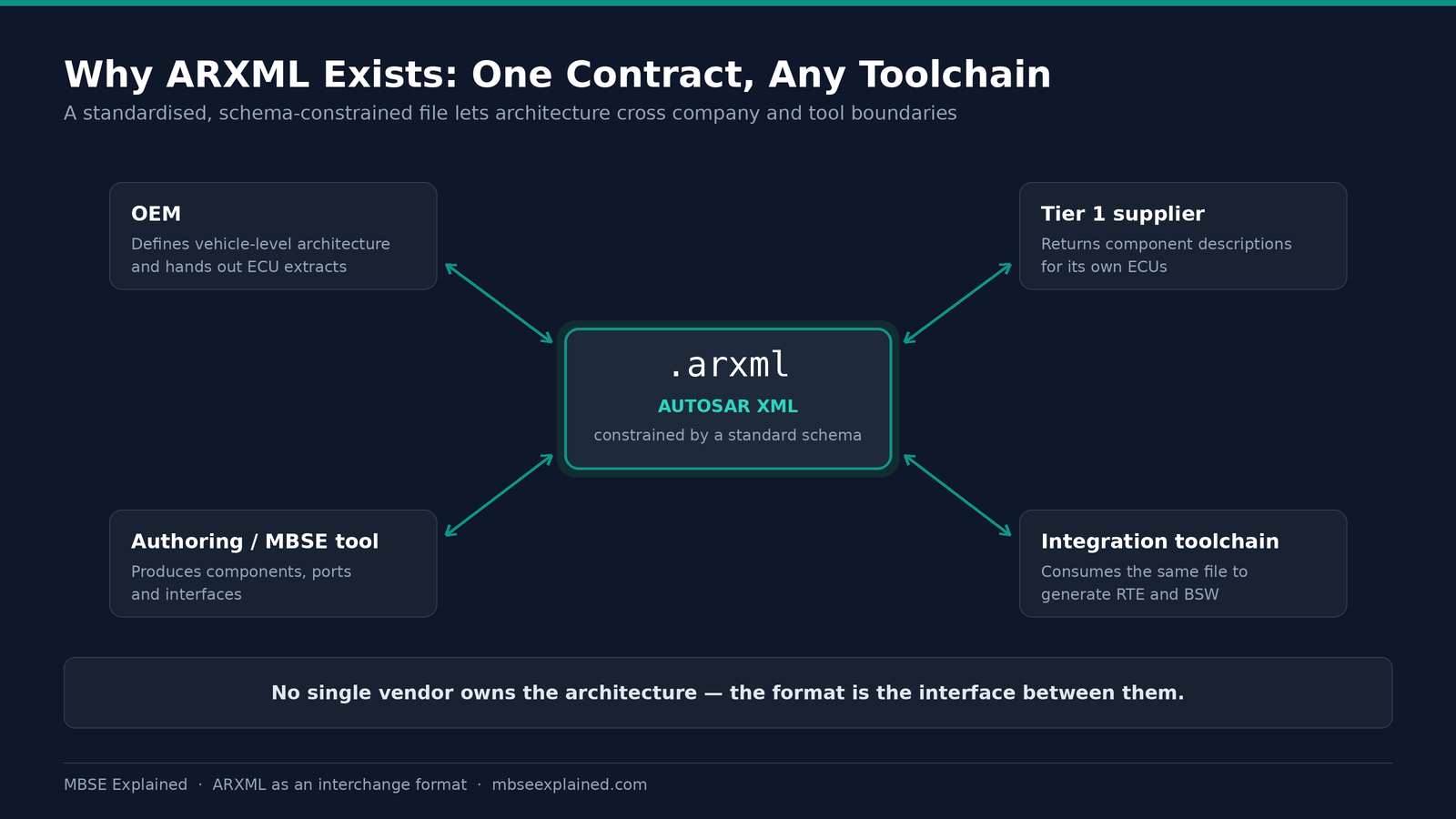
The reason the format exists at all is exchange. Automotive programs are built by many companies using many different tools — OEMs, Tier 1 suppliers, tool vendors — and none of them want to be locked into a single toolchain. A standardized, tool-agnostic file format means an architecture defined in one tool can be handed to another party and read in theirs. ARXML is that interchange contract.
What's Inside an ARXML File
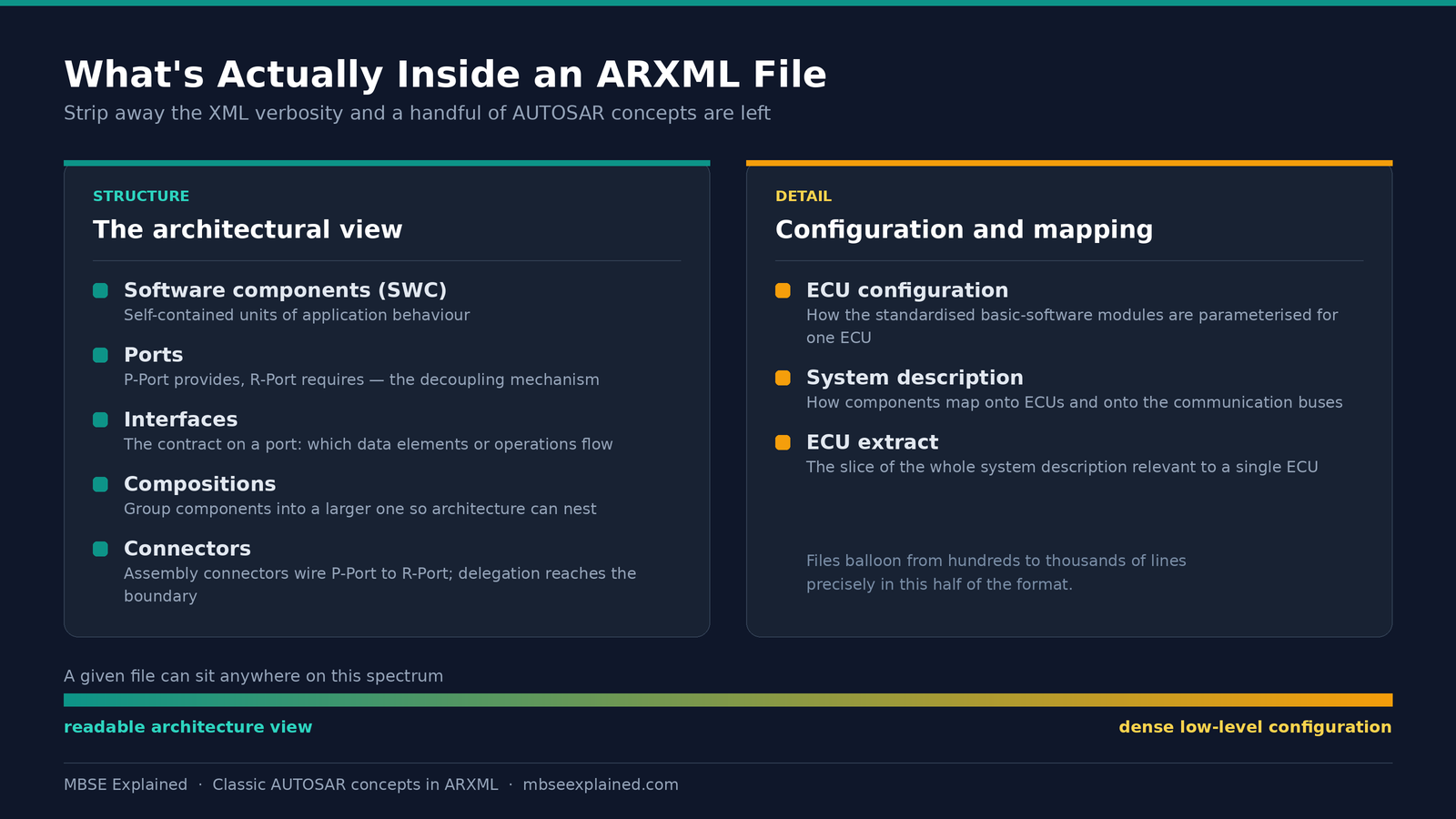
Strip away the XML verbosity and an ARXML file is describing a handful of core concepts. For Classic AUTOSAR — the platform running on the deeply embedded ECUs in a vehicle — the ones you meet most often are:
- Software Components (SWCs) — the building blocks of the application. A
SensorSWC, aControllerSWC, anActuatorSWC. Each is a self-contained unit of behavior. - Ports — how a component talks to the outside world. A P-Port (provider) offers data or a service; an R-Port (requirer) consumes it. This provider/requirer split is the heart of how AUTOSAR components stay decoupled.
- Interfaces — the contract on a port: what data elements or operations flow through it. Two components only connect cleanly if their ports share a compatible interface.
- Compositions — a way to group components into a larger component, so the architecture can be nested rather than flat. A composition has its own ports and holds other components inside it.
- Connectors — the actual wiring. Assembly connectors join one component's P-Port to another's R-Port; delegation connectors pass a composition's internal port out to its boundary.
On top of that structural picture, ARXML also carries the ECU configuration (how the standardized basic-software modules are parameterized for a specific ECU) and system description information (how components map onto ECUs and onto the communication buses between them). A file called an ECU extract is exactly what it sounds like — the slice of the whole system description relevant to one ECU.
You don't need to hold all of that in your head. The point is that ARXML spans a spectrum: at one end, a clean architectural view of components and how they're wired; at the other, dense low-level configuration. A given file might be mostly one or mostly the other.
Where ARXML Sits in the Workflow
ARXML isn't a thing you sit down and write. It's generated and consumed at several points along the AUTOSAR development flow, roughly like this:
- System and software architecture is defined — increasingly in an MBSE or dedicated AUTOSAR authoring tool — producing ARXML that describes the components, their ports, and their interfaces.
- That ARXML is exchanged between parties. An OEM hands an ECU extract to a Tier 1; a Tier 1 hands component descriptions back. This is where the format's standardization earns its keep.
- The descriptions drive RTE and basic-software configuration — the AUTOSAR Runtime Environment that actually glues components to each other and to the ECU is generated from what the ARXML specifies.
- Throughout, ARXML gets reviewed, integrated, and diffed as the architecture evolves — which is where a lot of day-to-day engineering time actually goes.
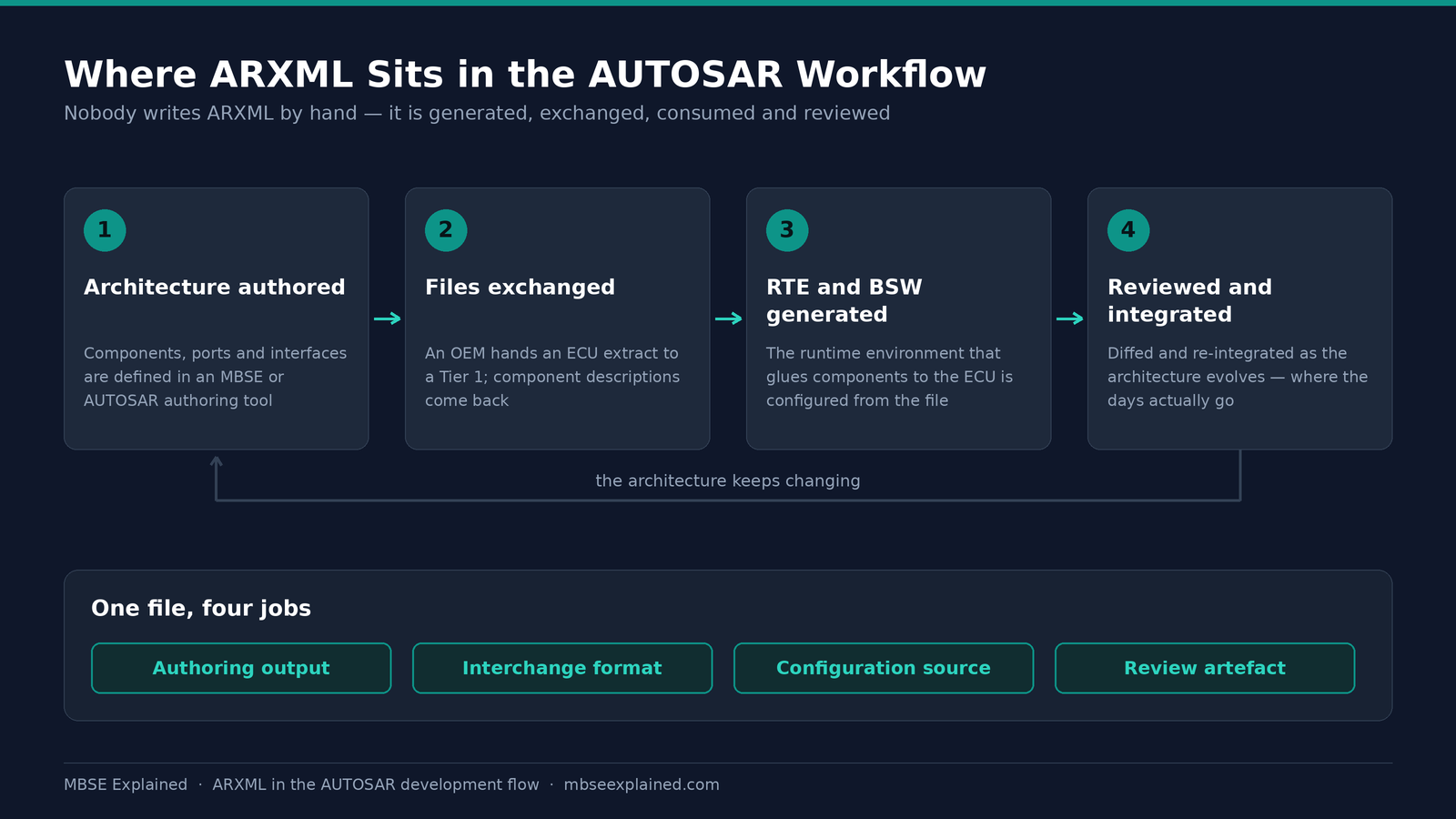
So ARXML is simultaneously an authoring output, an interchange format, a configuration source, and a review artifact. That's a lot of jobs for one file type, and it's why ARXML files end up everywhere in an automotive software program.
Why the Raw File Is So Hard to Read
Here's the honest tension at the center of ARXML: it's designed to be machine-readable and unambiguous, which is the right call for a format that tools generate and consume — and that same design makes it miserable for a human to read directly.
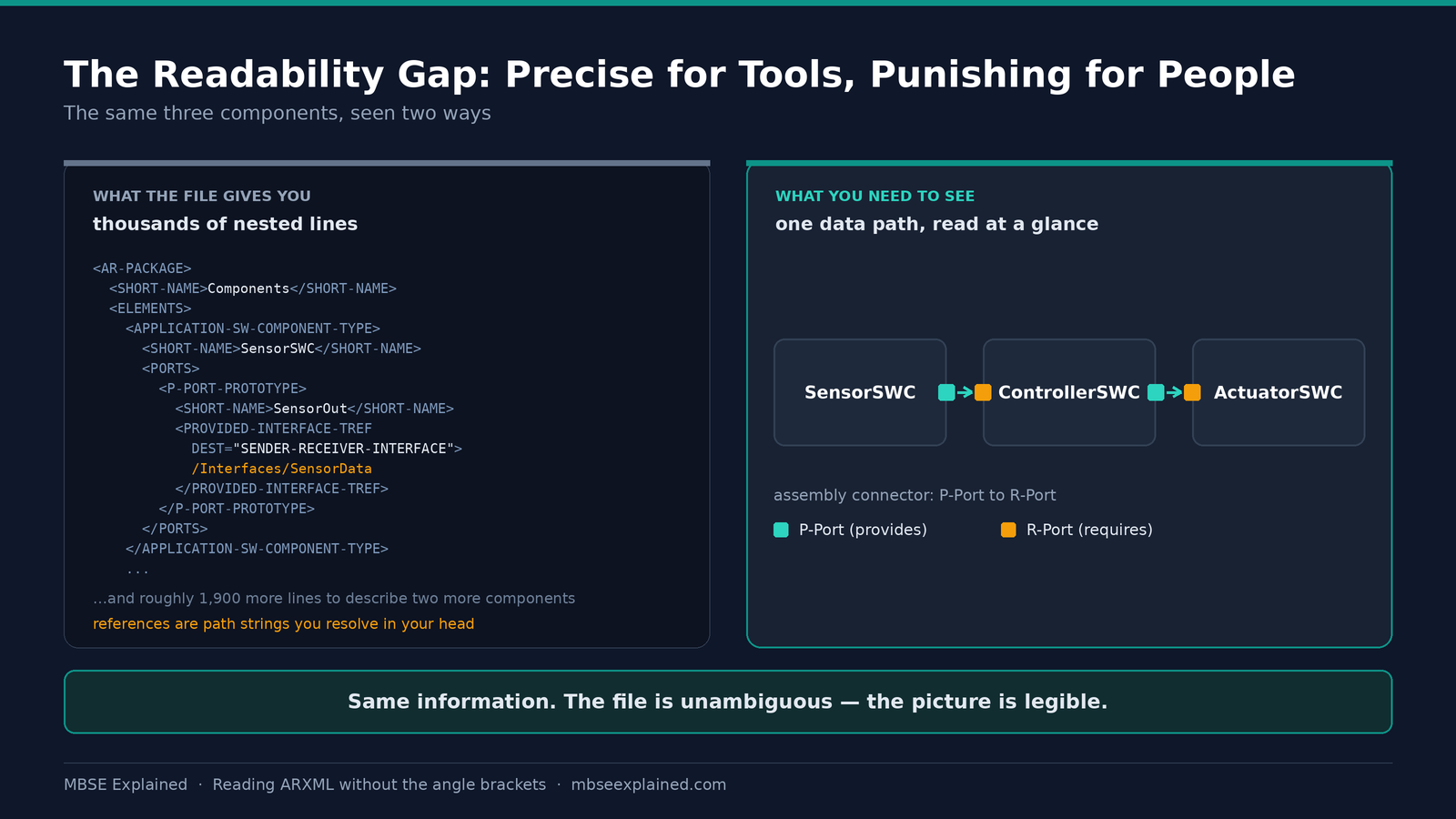
A trivial architecture — three components, a few ports, a connector or two — can run to thousands of lines of nested XML, with references between elements expressed as long path-like strings rather than anything you can follow visually. The information is all there, precisely. It's just not shaped for a person. Nobody looks at raw ARXML and immediately sees "ah, SensorSWC's output feeds ControllerSWC, which drives ActuatorSWC." You see that in a diagram. In the XML, that same fact is scattered across component definitions, port definitions, interface definitions, and connector definitions, tied together by references you have to resolve in your head.
That gap — between what the file contains and what a human can see — is the whole reason tooling exists around ARXML. The banner on this post is exactly that translation: the same components, ports, and connectors an ARXML describes, rendered as a graph you can actually read at a glance.
Pulling It Together
ARXML is the standardized XML format AUTOSAR uses to describe automotive software architecture — components, ports, interfaces, connectors, and ECU configuration — and it exists so that a fragmented, multi-vendor toolchain can exchange that architecture without lock-in. It's central, it's precise, and in raw form it's almost unreadable by design, which is why nobody actually works with it as text if they can help it.
That sets up the more uncomfortable question I want to tackle next: given that you constantly need to read these files — to review a supplier's work, to understand something a colleague sent, to sanity-check an integration — why is simply opening one so often gated behind an expensive tool license? That's the subject of the next post.
That's the mission here at MBSE Explained — simplifying systems for smarter EVs. If ARXML has ever ruined an afternoon for you, tell me how in the comments — I'd like to hear which part of the format trips your team up most.