Automotive SPICE 4.0 and MBSE - Aligning Model-Based Engineering with ASPICE Compliance

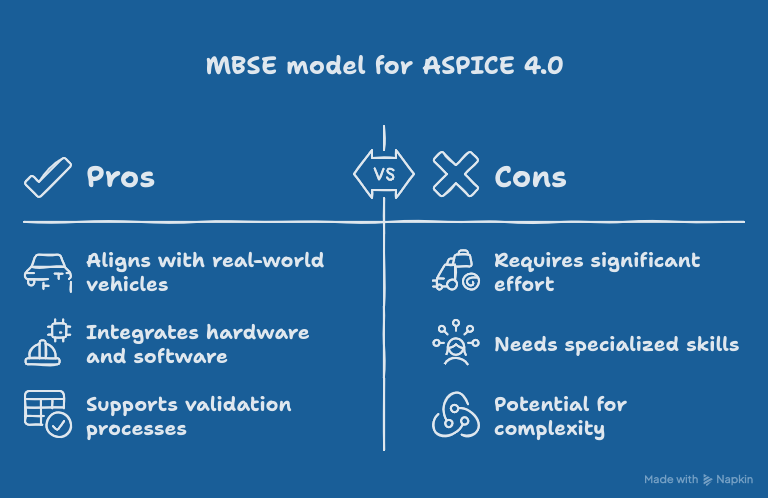 Where a well-structured MBSE model naturally produces the evidence an ASPICE 4.0 assessor is looking for — and where it doesn't.
Automotive SPICE (ASPICE) 4.0 did something the previous versions never quite managed: it started to look like the vehicles teams are actually building. Where earlier revisions centered on software with everything else bolted around the edges, 4.0 pulled hardware engineering, machine learning engineering, and a dedicated validation process group into scope as first-class citizens. For anyone building mechatronic, software-defined EVs, that's less a paperwork update and more the framework finally catching up to reality.
Welcome to MBSE Explained. There's good news for MBSE practitioners buried in this change: a well-run model-based approach naturally produces much of the evidence an ASPICE assessor is hunting for. The catch is the word naturally — it only holds if the model was structured around traceability from the start. This post walks through where MBSE and ASPICE 4.0 line up in practice, and the specific places teams tend to trip.
What Changed in 4.0
For teams coming from ASPICE 3.1, the shifts that matter most are structural. Hardware Engineering (HWE) processes now cover hardware requirements, design, and verification as their own discipline rather than something implied under systems engineering. Machine Learning Engineering (MLE) processes address the data-driven components creeping into ADAS and beyond. A dedicated validation process group separates validation more cleanly from verification. And the generic practices were reworked, with more weight placed on documented strategy at the process level.
For EV and mechatronic programs, the HWE addition is the headline. Battery-management hardware, power electronics, sensor design — all of it now has an explicit process reference model to be assessed against. That's a real change in expectation, not a cosmetic one, and it's exactly the area where software-heavy MBSE cultures tend to be underinvested.
Where MBSE and ASPICE Quietly Agree
MBSE and ASPICE were never designed as a matched pair, but their goals overlap more than teams expect — which is why a good model does compliance work almost as a side effect.
Start with traceability, since it's the heart of both. ASPICE's evaluation criteria are built around bidirectional traceability between requirements, architecture, and test cases. A properly structured SysML model produces exactly that as a natural byproduct of modeling — the links aren't extra compliance work, they're how the model holds together in the first place. The same is true of requirement decomposition: ASPICE wants a clean path from stakeholder needs down through system, hardware, and software requirements, and that maps almost one-to-one onto a layered MBSE hierarchy. And on the consistency checks assessors run between requirements and design, a connected model simply drifts less than a set of documents that each get updated on their own schedule.
Making the Model Actually Assessment-Ready
Alignment in principle doesn't survive contact with an audit unless the model is built for it. A few habits make the difference:
- Model stakeholder requirements explicitly. Don't jump straight to system requirements. Assessors look specifically for evidence that stakeholder needs were captured and used to derive the system level — skipping that step is one of the more common findings.
- Give hardware and software their own requirement views. With HWE now a formal process group, hardware-specific requirements — component tolerances, thermal limits, physical interfaces — need to be traceable independently of software requirements, not blended into one undifferentiated list.
- Wire verification and validation back into the model. Test cases and validation results should reference the specific requirement or architectural element they cover, ideally as model relationships rather than a spreadsheet cross-reference maintained by hand and reconciled only under audit pressure.
- Document the modeling strategy itself. 4.0's reworked generic practices put more weight on documented strategy at the process level — and that includes the MBSE methodology, not just the technical requirements it produces.
- Let the model be the evidence source. Generating traceability reports, coverage matrices, and change-impact analyses directly from the model — instead of reconstructing them for the assessment — is where the efficiency actually shows up.
Where Teams Trip
Three failure modes come up repeatedly. The first is running MBSE and ASPICE as separate workstreams: systems engineers model in SysML while a quality team tracks compliance in a disconnected tool, and the traceability work quietly gets done twice. The second is under-modeling hardware — a habit that was survivable under 3.1 and is now a visible gap under HWE. The third is the most seductive: assuming that having a model equals compliance. It doesn't. A SysML model only satisfies ASPICE if it actually captures the traceability links, the decomposition rationale, and the verification linkage the assessor is looking for. An empty-but-tidy model passes no audits.
Pulling It Together
ASPICE 4.0's broader scope — hardware, machine learning, validation — plays directly to MBSE's strengths, but only when the model is deliberately structured around traceability from stakeholder need down to verification evidence. Build it that way and compliance evidence becomes something the model hands you as a matter of course, rather than a separate scramble in the weeks before an assessment.
That's the mission at MBSE Explained — simplifying systems for smarter EVs. If your team has been through a 4.0 assessment recently, share what worked and what surprised you in the comments.