Requirements Traceability in Automotive MBSE - From Stakeholder Needs to Software

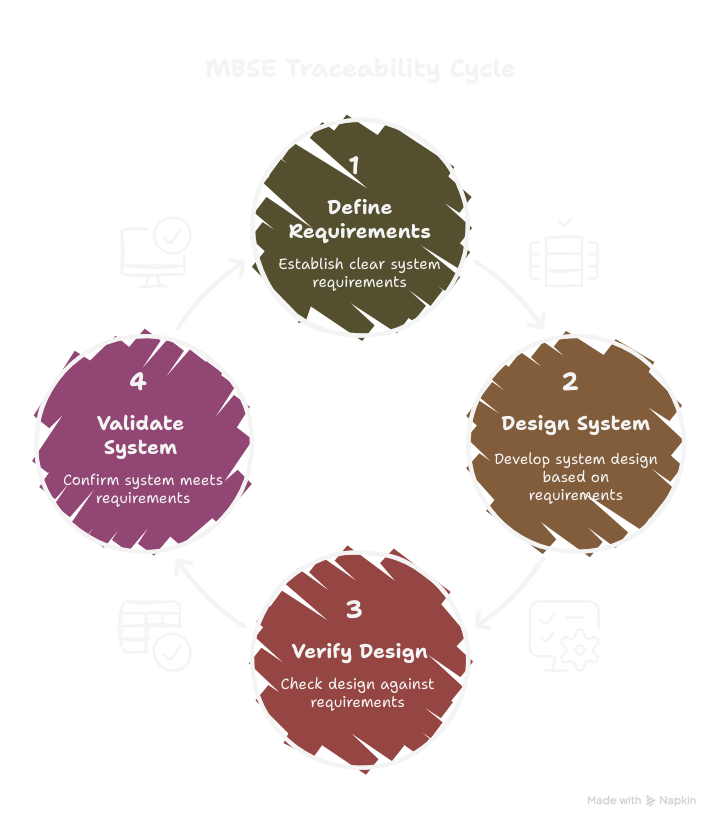 Building end-to-end requirements traceability from stakeholder needs down to software — and why a five-level structure holds up better than the flatter ones teams reach for first.
Ask an automotive systems engineer what they dread before an audit and "requirements traceability" comes up almost every time. The principle is trivially simple — every requirement should trace up to a stakeholder need and down to a verification result — and yet most programs still stitch it together from spreadsheets, legacy documents, and whatever tool each subteam happened to adopt. The matrix looks complete on a review slide right up until someone starts pulling on individual threads, and then the gaps show.
Welcome to MBSE Explained. Traceability is one of the problems MBSE exists to solve, but only if the model is structured for it deliberately. This post lays out how to build genuine end-to-end traceability in an automotive MBSE model — from stakeholder needs all the way to software implementation — and why a disciplined five-level structure tends to hold up better under pressure than the flatter hierarchies teams reach for first.
Why Traceability Rots in Automotive Programs
Automotive and EV programs are unusually good at breaking traceability, for reasons that are structural rather than careless. Different disciplines own different requirement types — mechanical, electrical, software, and safety teams each maintain their own view of the world. Requirements cross organizational boundaries constantly as OEMs and suppliers exchange them, losing context in translation each time. Programs churn requirements right through development, and any traceability matrix maintained by hand decays the instant nobody updates it after a change. And the heavyweight ALM platforms built to manage all this are often overkill for smaller hardware-focused teams, who quietly default back to spreadsheets — which is where traceability goes to die.
The result is the slide-deck matrix: complete-looking, reassuring in a review, and unable to survive an assessor or a defect investigation actually tracing a thread from top to bottom.
A Five-Level Structure That Holds Up
One pattern proves consistently durable, particularly for hardware-centric and IoT-adjacent programs: a five-level requirement hierarchy running Customer → Stakeholder → System → Hardware → Software.
- Customer — the commercial or contractual need driving the program.
- Stakeholder — needs from each stakeholder group: end users, regulators, service and maintenance, manufacturing.
- System — functional and non-functional requirements at the system level.
- Hardware — requirements tied to physical components, electronics, and mechanical design.
- Software — requirements implemented in embedded software and control logic.
The value isn't the number five. It's that every level has a clear owner and a clear decomposition rule for the level beneath it. A customer need decomposes into stakeholder needs; stakeholder needs into system requirements; system requirements split into hardware and software, each traceable straight back up the chain. When the rule for going down a level is explicit, the traceability going up a level takes care of itself.
Building It So It Actually Traces
Capture needs before requirements. Resist jumping straight to system requirements. Capture customer and stakeholder needs as first-class model elements even when they're informally worded at first — they're the anchor every downstream requirement traces back to, and the first artifact ASPICE and ISO 26262 assessors ask to see.
Use explicit relationships, not naming conventions. In SysML terms, satisfy relationships link architecture elements to the requirements they fulfill, and derive relationships connect requirements across levels. Don't lean on matching names or shared document sections to imply traceability — model it as an actual relationship, or it isn't really there.
Split hardware and software early. Once decomposition reaches the system level, force a clean separation between hardware and software requirements as soon as the structure allows. Mixing them in one undifferentiated list is a reliable source of downstream confusion, especially when the two teams ship on different cadences.
Link verification evidence into the model. A requirement isn't done until it's tied to a verification method and, eventually, a result — a test case, an analysis, an inspection record. That link belongs in the model, not in a separate test-management spreadsheet nobody reconciles until the audit.
Treat change impact as a first-class query. The real payoff of traceability isn't the audit trail. It's being able to ask "if I change this hardware requirement, what software, test cases, and stakeholder needs move?" and get a real answer in minutes instead of days.
The Tooling Trap
This is where a lot of smaller ODM and hardware-focused teams get stuck. Heavyweight automotive ALM platforms like Codebeamer are built for large OEM programs and carry all the process overhead that implies. Lightweight tools like ReqView are easy to adopt but tend to lack the structured hierarchy and traceability depth that hardware teams need once a program outgrows a handful of requirements. The uncomfortable middle — too heavy on one side, too thin on the other — is exactly the gap ODM Trace was built to fill, structured around this same five-level hierarchy for non-automotive IoT hardware teams that need real traceability without automotive-grade process weight.
Pulling It Together
End-to-end traceability isn't a documentation chore; it's an architectural discipline. Give the model clear levels, explicit relationships, and verification links built in from the start, and traceability stops being something you reconstruct in a panic before an audit and becomes something the model simply gives you.
That's the mission at MBSE Explained — simplifying systems for smarter EVs. How is your team handling traceability today — modeled relationships, or a spreadsheet everyone's afraid to touch? Share it in the comments.