MBSE for EV Powertrain Design - Applying SysML to Battery and Converter Systems

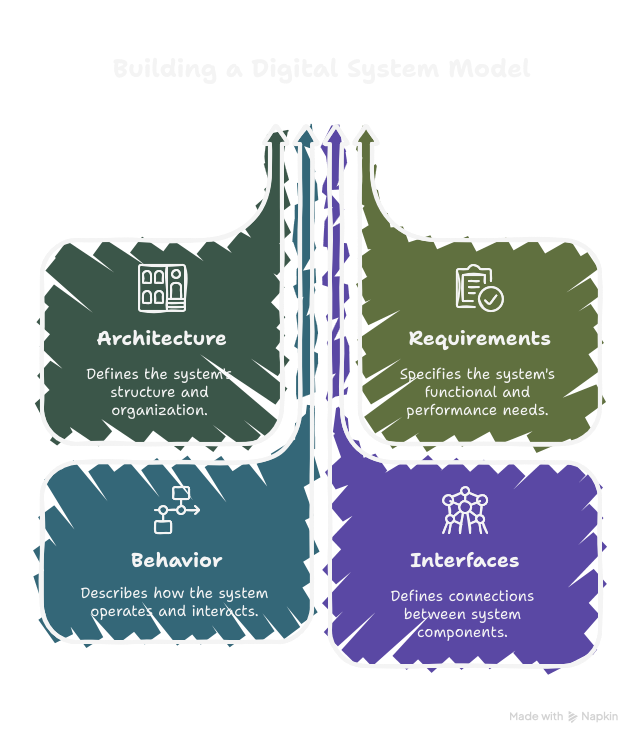 Applying SysML to battery management and DC-DC converter design across the EV powertrain.
On nearly every EV program there's a moment where the powertrain stops being a tidy block diagram and turns into a fight. It usually starts small: someone nudges the DC-DC converter's switching frequency to claw back a thermal margin, the change gets waved through because it's "just a parameter," and three weeks later EMC comes back with a compliance problem nobody has connected to that decision. The change was reasonable. The failure was that nothing in the toolchain made the coupling visible until the hardware said so the hard way.
That gap — between a defensible local decision and its non-obvious system consequences — is what Model-Based Systems Engineering (MBSE) is actually for. Welcome to MBSE Explained. This post gets specific about how MBSE and SysML apply to EV powertrain design in particular: not the marketing version, but the parts that earn their place on real programs. Battery management, power electronics, the control software tying them together — the same discipline runs through all of it. Model early, model precisely, and let the model carry the traceability so a human doesn't have to reconstruct it by hand every time something moves.
Why the Powertrain Punishes Document-Based Engineering
The powertrain is where document-based engineering falls apart fastest, and it's worth being honest about why. The coupling isn't loose — it's brutal. A battery management system (BMS) decision on charge-current limits reaches into thermal design, which sets the converter's derating curve, which constrains switching frequency, which lands right back on EMC compliance. That's four disciplines in one causal chain, and in a spreadsheet-and-Word world each one lives in a different file owned by a different person.
The requirements never sit still either. Range targets move, a cell-chemistry decision gets revisited, a charging standard shifts mid-program. Every change ripples across that same coupled chain, and a manually maintained traceability matrix starts decaying the moment nobody updates it after a change — which is to say, almost immediately.
Then there's the safety case. ISO 26262 assessors don't accept "the team knew." They want traceable evidence, and if that evidence is scattered across a dozen documents that drifted out of sync months ago, you're rebuilding it under deadline pressure. MBSE's answer is unglamorous but effective: make the model the single source of truth, not the document. Requirements, blocks, interfaces, and behavior live in one connected structure, and the connections are real relationships rather than a shared heading in a Word file.
Structuring the Powertrain in SysML
The practical starting point is a layered decomposition that mirrors both the physical build and the logical architecture. At the top sits the electric powertrain as a system — motor, inverter, BMS, DC-DC converter, thermal management. That decomposes into hardware (cell modules, power-electronics boards, sensors, connectors) and software (torque control, state-of-charge estimation, converter switching logic).
In SysML terms, a handful of diagram types do most of the real work:
- Block Definition Diagrams (BDD) capture the structural hierarchy — what the powertrain is made of.
- Internal Block Diagrams (IBD) show how power and signals actually flow between the BMS, converter, and inverter. This is where interface discipline lives or dies.
- State Machine Diagrams model battery behavior across charging, discharging, fault, and thermal-derate states.
- Requirement Diagrams tie each functional requirement to the blocks that satisfy it.
The payoff isn't the diagrams themselves — it's what they let you ask. Change the converter's switching frequency in a model built this way, and the tool tells you immediately which requirements, interfaces, and test cases just moved. That's exactly the question that otherwise takes three weeks and an EMC lab to answer.
The DC-DC Converter as a Working Example
The converter is worth dwelling on because it sits at the intersection of every discipline in the powertrain, which makes it a brutally honest test of a model. Electrically it has input and output voltage ranges, a switching topology, ripple tolerances. Thermally it has derating curves and a cooling-interface requirement. In software it has a closed-loop voltage regulator, fault detection, and diagnostics reporting onto a bus.
Model the converter as a SysML block with its ports drawn explicitly — power in, power out, control signals, diagnostic bus — and something useful happens. A top-level requirement like "the converter shall hold output voltage within ±2% under full load" stops being a line in a spec and becomes a thread you can pull. It traces down through the control-loop parameters in the software model and across to the thermal interface that has to hold up under that load. When a design review reaches that requirement, nobody is arguing from memory — the actual chain of things that must be true is right there, along with where the current design puts each of them.
Where ISO 26262 Actually Fits
Powertrains are full of safety-relevant elements — traction inverter control, high-voltage disconnect logic, the interlocks around them. This is where MBSE and ISO 26262 stop being two separate workstreams and start reinforcing each other, provided it's set up right.
The hazard analysis and risk assessment (HARA) doesn't have to live in its own document. Its outputs — the hazards, the safety goals — can be modeled as requirements linked straight to the system blocks they constrain. Safety goals then decompose into functional safety requirements at each architectural level, following the same decomposition the architecture already uses. And the traceability matrix an assessor asks for stops being something assembled by hand the week before the audit; it's generated from the model, because the links were already there.
That shift is the one that changes how teams feel about safety work. Done well, the safety case stops being a frantic document exercise bolted on at the end and becomes a byproduct of the engineering that was happening all along.
The Mistakes That Show Up Most Often
A few failure patterns appear again and again, usually in teams new to MBSE:
- Modeling everything before modeling anything useful. The instinct to capture the whole powertrain at once produces a model that's exhaustive and inert. Start with the critical interfaces — the ones where the painful coupling lives — and expand from there.
- Treating the model as prettier documentation. If it just illustrates decisions made elsewhere in meetings, it will rot. The model has to drive the analysis and the reviews, or it's pure overhead.
- Leaving the requirements tool disconnected from the model. This is the quiet killer. If the requirements management tool can't link into the SysML model, the old silos have been faithfully recreated — which is exactly what MBSE was supposed to dissolve.
That last one bites smaller teams hardest — the ones building EV or IoT-adjacent hardware who don't have the budget or the appetite for a heavyweight automotive ALM suite, but still need genuine requirement-to-architecture traceability rather than another spreadsheet pretending to be a matrix.
Pulling It Together
MBSE isn't magic, and anyone who sells it that way hasn't shipped with it. Pointed deliberately at EV powertrain design, though, it turns a knot of interdependent electrical, thermal, and software requirements into something you can actually reason about before hardware makes the decision for you. Start with the interfaces that hurt, connect requirements to blocks early, and let the model carry the traceability you'd otherwise be rebuilding by hand every time something changes.
That's the whole mission here at MBSE Explained — simplifying systems for smarter EVs. If you're wrestling with your own powertrain modeling right now, share where it's snagging in the comments. What's working on your program, and what's fighting you?